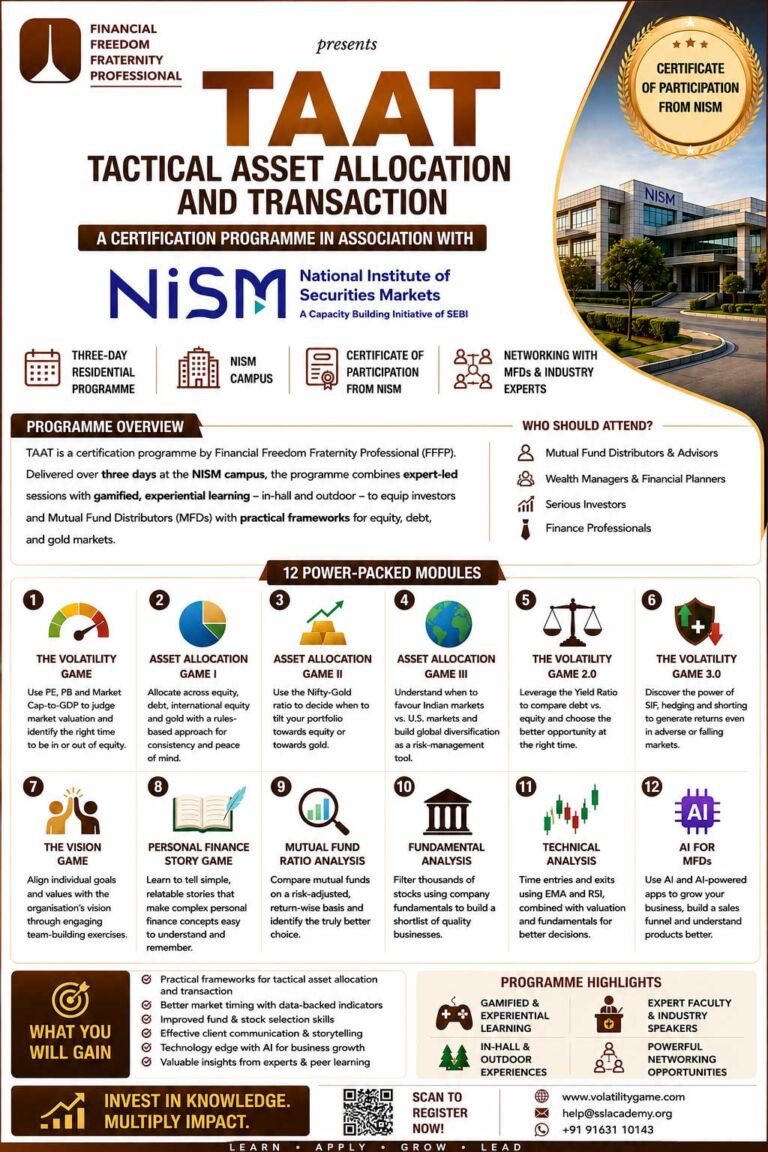
Tactical Asset Allocation and Transaction (TAAT) is a certification programme conducted by the Financial Freedom Fraternity Professional (FFFP), with participants receiving a Certificate of Participation from NISM on completion. The programme is delivered over three days at the NISM campus and is built around twelve experiential learning modules — the FFFP suite of games and frameworks — designed to give investors and Mutual Fund Distributors (MFDs) a structured, practical understanding of equity, debt, and gold markets.
Across the three days, sessions are led by external speakers who are subject-matter experts in their respective fields, alongside the FFFP module facilitators. The format combines classroom learning with gamified, experiential exercises — both inside and outside the main hall — so that participants absorb concepts by engaging with them directly, rather than through lectures alone. The programme also serves as a networking opportunity, bringing participants together to learn from each other over the course of the three days.
The curriculum comprises twelve modules, progressing from market-timing fundamentals through asset allocation, fund and stock selection, and finally into communication and technology skills for MFDs:
This foundational module introduces the essence of portfolio rebalancing through three core market indicators: the Price-to-Earnings (PE) ratio, the Price-to-Book (PB) ratio, and the Market Cap-to-GDP ratio. Participants learn to read these parameters together to judge market valuation, building the ability to identify a good time to be invested in equity — and, just as importantly, a good time to stay out of it.
This module trains participants to allocate investments across asset classes — equity, debt, international equity, and gold. The emphasis is on consistency and discipline: a structured, rules-based approach to spreading investments across classes that reduces reactive decision-making and gives investors genuine peace of mind through market cycles.
Building on Module 2, this session focuses on the interplay between Nifty and Gold using the Nifty-Gold ratio as a decision-making tool. Participants learn how this ratio signals when to tilt a portfolio toward equity and when to tilt it toward gold.
This module extends the allocation framework across geographies, examining when to favour Indian markets versus U.S. markets under different macroeconomic and market scenarios. It builds an understanding of global diversification as a risk-management tool.
This module introduces the yield ratio, a key metric for comparing the relative attractiveness of debt and equity at any given point in time. Participants learn to use this ratio to judge when it is a good time to invest in debt instruments and when equity offers the better opportunity.
This module introduces SIF (Specialised Investment Fund), covering the mechanics and power of hedging and shorting. Participants explore how disciplined use of these tools can help generate returns even in adverse or falling markets.
A team-building module centred on alignment. Participants work through exercises that surface individual goals and values, and connect them with the broader vision of their organisation — building shared purpose and stronger working relationships.
In this module, participants become storytellers. They learn to translate technical personal-finance concepts into simple, relatable narratives — a skill that makes complex ideas easier to communicate and easier for investors to retain.
This module addresses a common challenge: choosing between mutual funds that all look “good” on the surface. Participants learn to compare funds on a risk-adjusted, return-wise basis, using ratio analysis to identify the fund that is genuinely the better choice for a given objective.
This module teaches participants how to identify preferred stocks from a universe of thousands, using company fundamentals as the filter. It builds a practical, repeatable process for narrowing a broad market down to a shortlist of quality businesses.
This module covers how to time entries into, and exits from, equity positions using technical indicators — including the Exponential Moving Average (EMA) and the Relative Strength Index (RSI). Participants learn to combine these tools with the fundamental and valuation frameworks covered earlier in the programme.
The closing module is designed specifically for Mutual Fund Distributors (MFDs), covering how to use artificial intelligence and AI-powered applications to grow their business. Topics include sales strategy, building a sales funnel, and developing a deeper, AI-assisted understanding of each product on offer.